missing translation for 'onlineSavingsMsg'
Få mere at vide

Invitrogen™ Occludin Polyclonal Antibody

Artikelnummer. 10632194
Skift visning
Klik for at se tilgængelige muligheder
Mængde:
100 μg
Pakningsstørrelse:
100µg
1 product options available for selection
Product selection table with 1 available options. Use arrow keys to navigate and Enter or Space to select.
Artikelnummer. Mængde Pakningsstørrelse
10632194 100 μg 100µg
Use arrow keys to navigate between rows. Press Enter or Space to select a product option. 1 options available.
1 options
Denne vare kan ikke returneres. Se returpolicy
Artikelnummer. 10632194 Leverandør Invitrogen™ Leverandørnr. 404700
  • ONLINE EXCLUSIVE PRICE
    3970.00 DKK
    3414.65 DKK / 100µg
    Spare 555.35 DKK
    13% Slukket
Se alle kampagner
 Begrænset vare
På lager
Læg i indkøbskurv
Edge
Læg i indkøbskurv

missing translation for 'validMainframeMsg'

This item is not returnable. View return policy

Rabbit Polyclonal Antibody

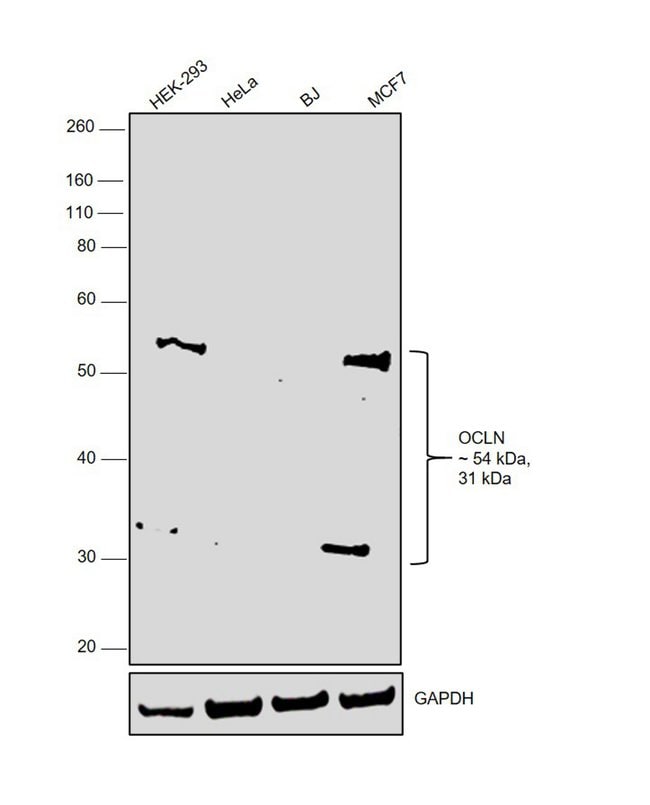
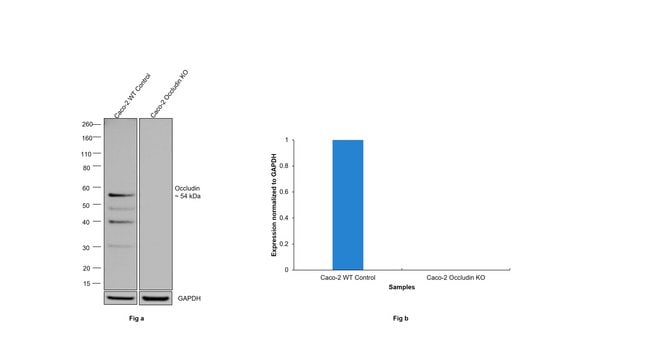
This antibody is specific for the human occludin protein. On western blots, it identifies the target band at ~65 kDa. Reactivity has been confirmed with human Caco-2 and HT29, dog MDCK, mouse TCMK, and rat KNRK cell lysates, and mouse kidney, liver, and rat liver homogenates by western blotting, Caco-2 cells by immunofluorescence, and paraffin-embedded human small intestine tissue by immunohistochemistry. For immunofluorescence using Caco-2 cells, fixation with cold ethanol is recommended. For immunohistochemistry in paraffin-embedded tissues, enzyme digestion with pepsin is required prior to staining.

Occludin is a 65 kDa protein that can exist in a variety of phosphorylated forms, ranging up to approximately 82 kDa. Occludin is thought to be involved in regulating both the localization and the function of occludin. Polyunsaturated fatty acids are known to up-regulate occludin expression, increasing the transendothelial cell resistance and reducing the cellular permeability to large molecules. The level of occludin varies greatly depending on tissue; in brain tissue, occludin is highly and continuously expressed at cell-cell contact sites, whereas non-neural tissues show lower expression and discontinuous distribution. Overall structural features of the occludin protein are highly conserved in all the species examined. Under-expression of tight junction proteins, including occludin, is a key molecular abnormality responsible for the increased permeability of tumor endothelial tight junctions, which contributes to brain tumor edemas.
TRUSTED_SUSTAINABILITY

Specifications

Antigen Occludin
Applikationer Immunohistochemistry (Paraffin), Western Blot, Immunocytochemistry
Klassifikation Polyclonal
Koncentration 0.25 mg/mL
Konjugeret Unconjugated
Formulering PBS with 0.1% sodium azide; pH 7.4
Gene OCLN
Genadgangsnr. Q16625, Q28269, Q61146, Q6P6T5
Gene Alias AI503564; BLCPMG; Occludin; occludin 1B; Ocl; Ocln; phosphatase 1, regulatory subunit 115; PPP1R115; tight junction protein occludin; tight junction structural protein
Gensymboler OCLN
Værtsarter Rabbit
Immunogen Synthetic peptide derived from the C-terminal region of the human occludin protein.
Oprensningsmetode Antigen affinity chromatography
Mængde 100 μg
Regulatorisk status RUO
Primær eller sekundær Primary
Gen-id (Entrez) 100506658, 18260, 403844, 83497
Målarter Canine, Human, Mouse, Rat
Indhold og opbevaring -20°C
Produkttype Antibody
Form Liquid
Isotype IgG
Show More Show Less
Product Title
Select an issue

By clicking Submit, you acknowledge that you may be contacted by Fisher Scientific in regards to the feedback you have provided in this form. We will not share your information for any other purposes. All contact information provided shall also be maintained in accordance with our Privacy Policy.
