missing translation for 'onlineSavingsMsg'
Få mere at vide
Få mere at vide
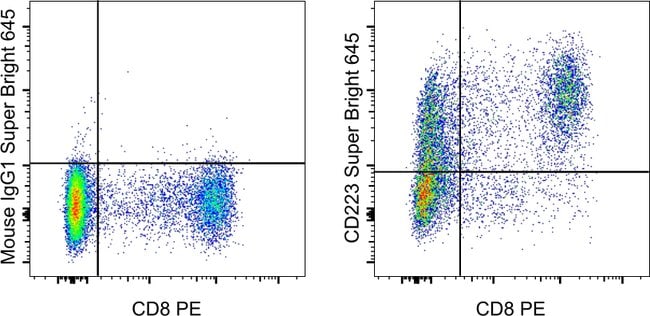
Invitrogen™ CD223 (LAG-3) Monoclonal Antibody (3DS223H), Super Bright™ 645, eBioscience™, Invitrogen™

Mouse Monoclonal Antibody
Brand: Invitrogen™ 64-2239-42
Denne vare kan ikke returneres.
Se returpolitik
Beskrivelse
Description: The J105 monoclonal antibody reacts with the human PD-1 (programmed death-1), a 55 kDa member of the CD28 immunoglobulin superfamily. PD-1 contains the immunoreceptor tyrosine-based inhibitory motif (ITIM) and plays a key role in peripheral tolerance and autoimmune disease. PD-1 is expressed predomitly on activated T and B lymphocytes. Two novel members of the B7 family have been identified as the PD-1 ligands, PD-L1 (B7-H1) and PD-L2 (B7-DC). Evidence reported to date suggests overlapping functions for these two PD-1 ligands and their constitutive expression on some normal tissues and upregulation on activated antigen-presenting cells. Costaining experiments suggest that eBioJ105 recognizes a different epitope than MIH4 (cat. 11-9969). Applications Reported: This eBioJ105 (J105) antibody has been reported for use in flow cytometric analysis. Applications Tested: This eBioJ105 (J105) antibody has been pre-titrated and tested by flow cytometic analysis of PHA stimulated human peripheral blood cells. This can be used at 5 μL (0.25 μg) per test. A test is defined as the amount (μg) of antibody that will stain a cell sample in a final volume of 100 μL. Cell number should be determined empirically but can range from 10^5 to 10^8 cells/test. Super Bright 645 is a tandem dye that can be excited with the violet laser line (405 nm) and emits at 645 nm. We recommend using a 660/20 bandpass filter.
LAG-3 is a 70-kDa surface glycoprotein in the immunoglobulin superfamily, with structural homology to CD4. It binds to MHC class II molecules with higher affinity than CD4 and is involved in the negative regulation of T cell activation and homeostatic proliferation. LAG-3 is expressed on the surface of activated T cells, including regulatory T cells, and NK cells. Notably, CD8+ T cells express LAG-3 at significantly higher levels than CD4+ T cells. Additionally, the coexpression of LAG-3 and CD49b has been proposed as a marker for identifying Type 1 regulatory T cells (Tr1 cells) in both humans and mice. This highlights LAG-3s role in immune regulation and its potential as a target for therapeutic interventions in immune-related conditions.
Tekniske data
| CD223 (LAG-3) | |
| Monoclonal | |
| 5 μL/Test | |
| PBS with BSA and 0.09% sodium azide; pH 7.2 | |
| P18627 | |
| LAG3 | |
| hCD223-FC PFA 4%. | |
| 100 Tests | |
| Primary | |
| Human | |
| Antibody | |
| IgG1 κ |
| Flow Cytometry | |
| 3DS223H | |
| Super Bright 645 | |
| LAG3 | |
| Activation-induced cytidine deaminase-linked autoimmunity protein; Aida; CD223; FDC; LAG3; LAG-3; Ly66; lymphocyte activating 3; lymphocyte activation gene 3 protein; lymphocyte-activation gene 3; Secreted lymphocyte activation gene 3 protein; sLAG 3; sLAG3; sLAG-3; soluble LAG 3lymphocyte activating 3; soluble LAG3 | |
| Mouse | |
| Affinity chromatography | |
| RUO | |
| 3902 | |
| 4°C, store in dark, DO NOT FREEZE! | |
| Liquid | |
| Responsibly packaged |
Korrektion af produktindhold
Dit input er vigtigt for os. Udfyld denne formular for at give feedback relateret til indholdet på dette produkt.
Produkttitel
Ser du en mulighed for forbedring?Del en indholdskorrektion