missing translation for 'onlineSavingsMsg'
Få mere at vide
Få mere at vide
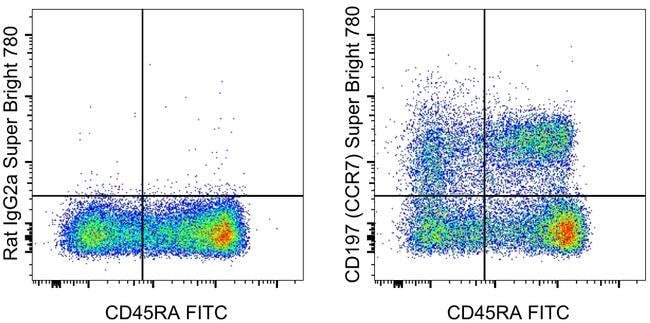
Invitrogen™ CD197 (CCR7) Monoclonal Antibody (3D12), Super Bright™ 780, eBioscience™, Invitrogen™
Rat Monoclonal Antibody
Brand: Invitrogen™ 78-1979-42
Denne vare kan ikke returneres.
Se returpolitik
Beskrivelse
Description: This F38-2E2 monoclonal antibody reacts with human CD366, also known as T cell immunoglobulin and mucin domain-containing protein 3 (TIM3) or HAVCR2. This cell surface receptor is expressed on activated CD4+ T cell subsets (e.g. Th1, Th17, and Treg), CD8+ T cells, monocytes, dendritic cells, and mast cells. Due to alternative splicing, CD366 exists as membrane-bound and soluble forms. Galectin-9 has been identified as the ligand for CD366. In humans, this receptor negatively regulates CD4+ T cells, influencing the secretion of some Th1- and Th17-related cytokines. CD366 has also been implicated in tolerance, autoimmune disease (e.g. multiple sclerosis), and HIV infection. Applications Reported: This F38-2E2 antibody has been reported for use in flow cytometric analysis. Applications Tested: This F38-2E2 antibody has been pre-diluted and tested by flow cytometric analysis of stimulated normal human peripheral blood cells. This may be used at 5 μL (0.06 μg) per test. A test is defined as the amount (μg) of antibody that will stain a cell sample in a final volume of 100 μL. Cell number should be determined empirically but can range from 10^5 to 10^8 cells/test. Super Bright 780 is a tandem dye that can be excited with the violet laser line (405 nm) and emits at 780 nm. We recommend using a 780/60 bandpass filter. Please make sure that your instrument is capable of detecting this fluorochrome.
CCR7 is a member of the G-protein-coupled chemokine receptor family with seven membrane-spanning domains and functions as a receptor for 6Ckine/SLC (secondary lymphoid-tissue chemokine), CCL19 and CCL21. CCR7 has been shown to be internalized via clathrin-coated pits and the majority recycled back to the plasma membrane. CCR7 is expressed on T cells and can be used to distinguish populations of naive from central and effector memory T cells. CCR7 has been shown to play a role in migration of memory T cells to inflamed tissue. Expression of CCR7 is also found on DC's. During DC maturation CCR7 expression increases and is thought to be involved in a variety of functions: chemotaxis to the lymph node, cellular architecture, rate of endocytosis, survival and maturation.
Tekniske data
| CD197 (CCR7) | |
| Monoclonal | |
| 5 μL/Test | |
| PBS with BSA and 0.09% sodium azide; pH 7.2 | |
| P32248 | |
| Ccr7 | |
| Affinity chromatography | |
| RUO | |
| 1236 | |
| 4°C, store in dark, DO NOT FREEZE! | |
| Liquid |
| Flow Cytometry | |
| 3D12 | |
| Super Bright 780 | |
| Ccr7 | |
| BLR2; Bukitt's lymphoma receptor 2; CC chemokine receptor 7; C-C chemokine receptor type 7; C-C CKR-7; C-C motif chemokine receptor 7; CC-CKR-7; CCR7; CCR-7; CD197; CDw197; chemokine (C-C motif) receptor 7; chemokine (C-C) receptor 7; Cmkbr7; EBI1; Ebi1h; EBV-induced G protein-coupled receptor 1; EBV-induced G-protein coupled receptor 1; Epstein-Barr virus induced gene 1; Epstein-Barr virus-induced G-protein coupled receptor 1; EVI1; lymphocyte-specific G protein-coupled peptide receptor; MIP-3 beta receptor | |
| Rat | |
| 100 Tests | |
| Primary | |
| Human | |
| Antibody | |
| IgG2a κ |
Korrektion af produktindhold
Dit input er vigtigt for os. Udfyld denne formular for at give feedback relateret til indholdet på dette produkt.
Produkttitel
Ser du en mulighed for forbedring?Del en indholdskorrektion